

[ Case study · EdTech ]
Building a Dual-Engine AI Assessment Platform
HeuriSight Education · AI Product Engineering
[ EdTech · AI Product Engineering ]
HeuriSight Education
The problem
HeuriSight needed an AI system that could do something no existing tool handles well: analyse student work, extract the cognitive decision-making patterns embedded in their responses, and map those patterns to educational competencies. This required combining document understanding (RAG) with heuristic reasoning (HAG) in a novel dual-engine architecture. The system needed to process diverse assessment formats, build knowledge graphs of student cognitive patterns, and present actionable insights to facilitators — all while maintaining the accuracy required for educational assessment.
What we built
The dual-engine architecture allows HeuriSight to do what neither RAG nor traditional rule-based systems can do alone: understand the content of student work AND extract the cognitive patterns that reveal how students think and make decisions. The triple-store data coordination ensures each type of data is stored in the right system — vectors for similarity, graphs for relationships, objects for documents — while presenting a unified view to facilitators.
- Architecture DesignWe designed a dual-engine architecture combining Retrieval-Augmented Generation for document understanding with Heuristics-Augmented Generation for cognitive pattern extraction. A triple-store data layer was planned — Pinecone for vector similarity search, Neo4j for relationship graphs and S3 for document storage — coordinated through a Redis caching layer.
- Core Engine DevelopmentBuilt the RAG engine for processing assessment documents and the HAG engine for applying a 10-category cognitive classification framework. The Goal-Precondition-Confidence framework was implemented to evaluate the strength of heuristic-to-competency translations. Both engines feed into a unified knowledge graph in Neo4j.
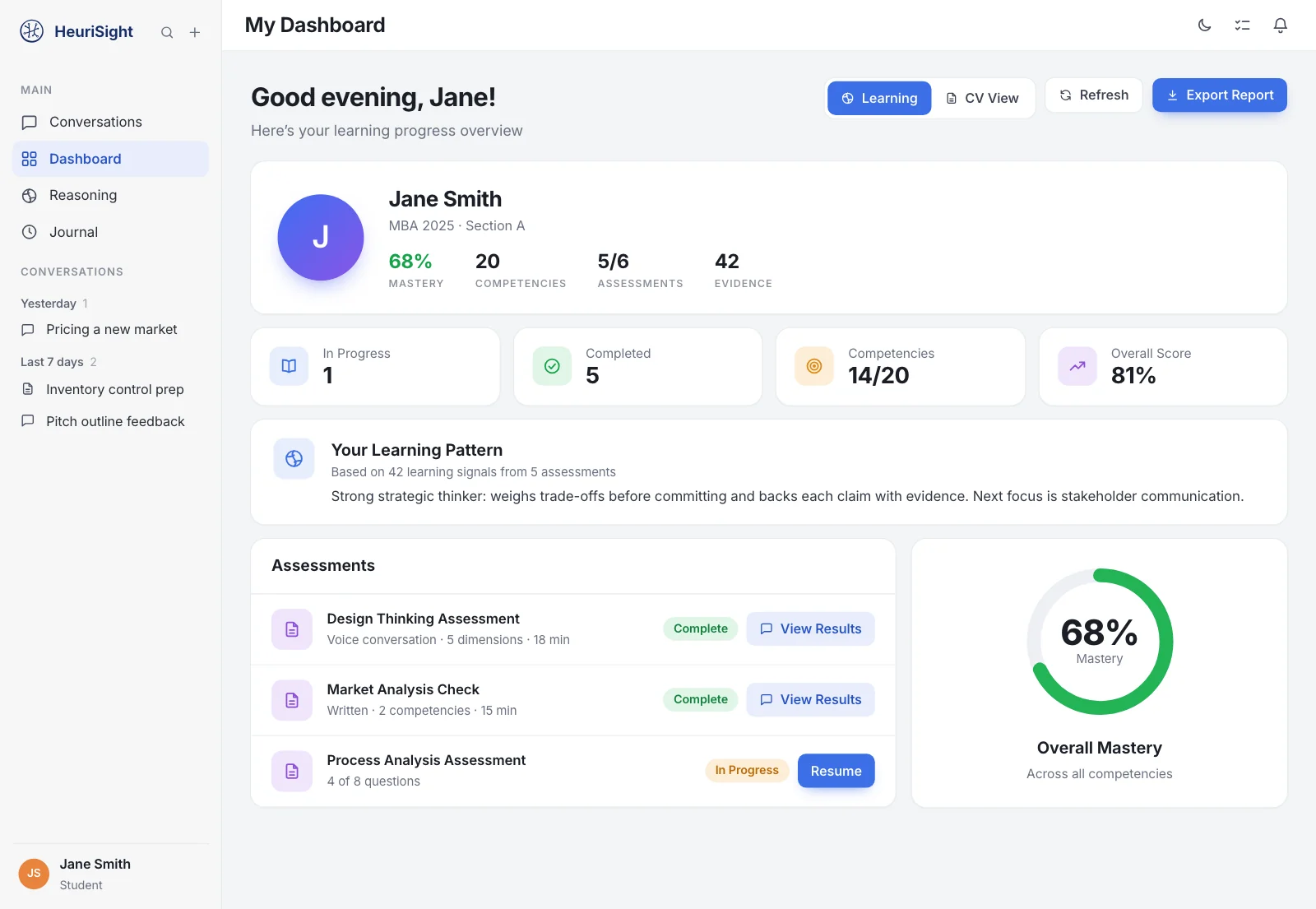
- Dashboard & AnalyticsDeveloped a facilitator dashboard with cohort management, assessment processing workflows, competency extraction views and analytics. 3D visualisation using Three.js and React Force Graph for exploring knowledge graphs. At-risk student identification and learning pathway derivation built into the analytics layer.